Worms in spectre tilings
- (NEW)Find here animations showing a walk along a worm (from tip to base) for both a (wriggly) worm at various
depths.
- Hydra: a pair of remarkable almost C-6 rotationally symmetric tilings (hydra and hydra2) discovered by
Pieter Mostert with 4 half-infinite, one bi-infinite worms and 4 half-infinite plus one bi-infinite
wriggly worms.
By reverting the bi-infinite worms one can obtain 12 distinct configurations in two equivalent classes if we allow
for 60 degrees rotations.
- The tripod pair (by Joshua Socolar) has the interesting feature of having two possible bi-infinite
worms sharing the first half of their path.
- How a worm deflates How worms transform under H7-H8 deflation.
- Short animation showing how a worm is reverted.
Here a similar animation for a wriggly worm.
less-wriggly worms
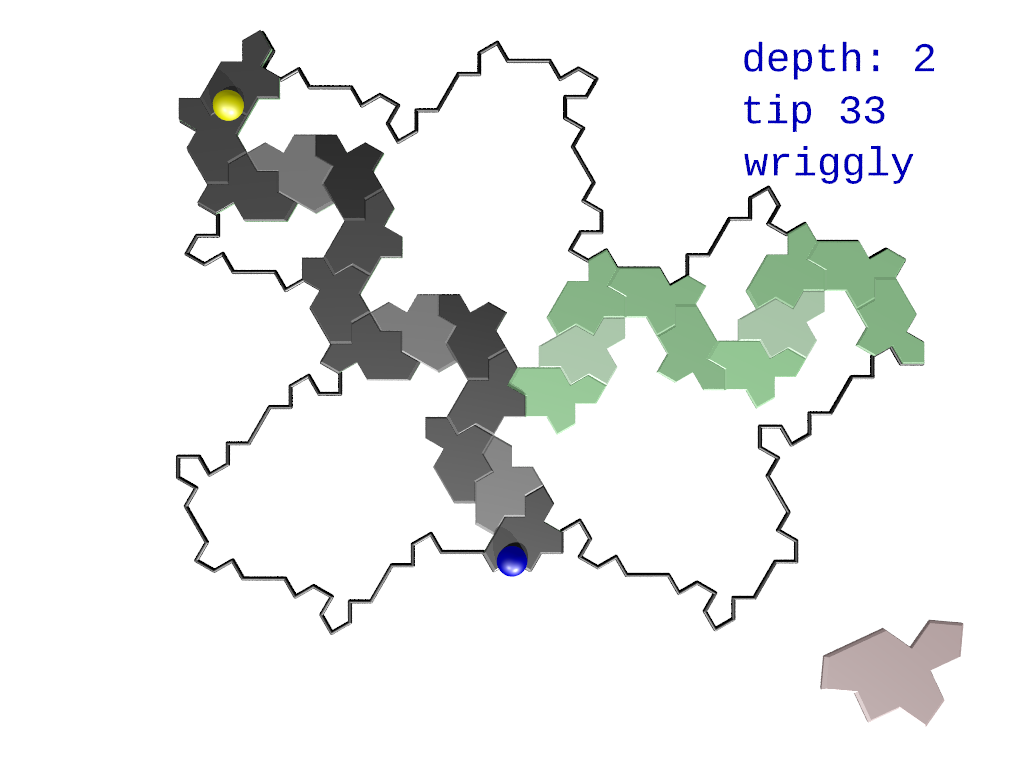
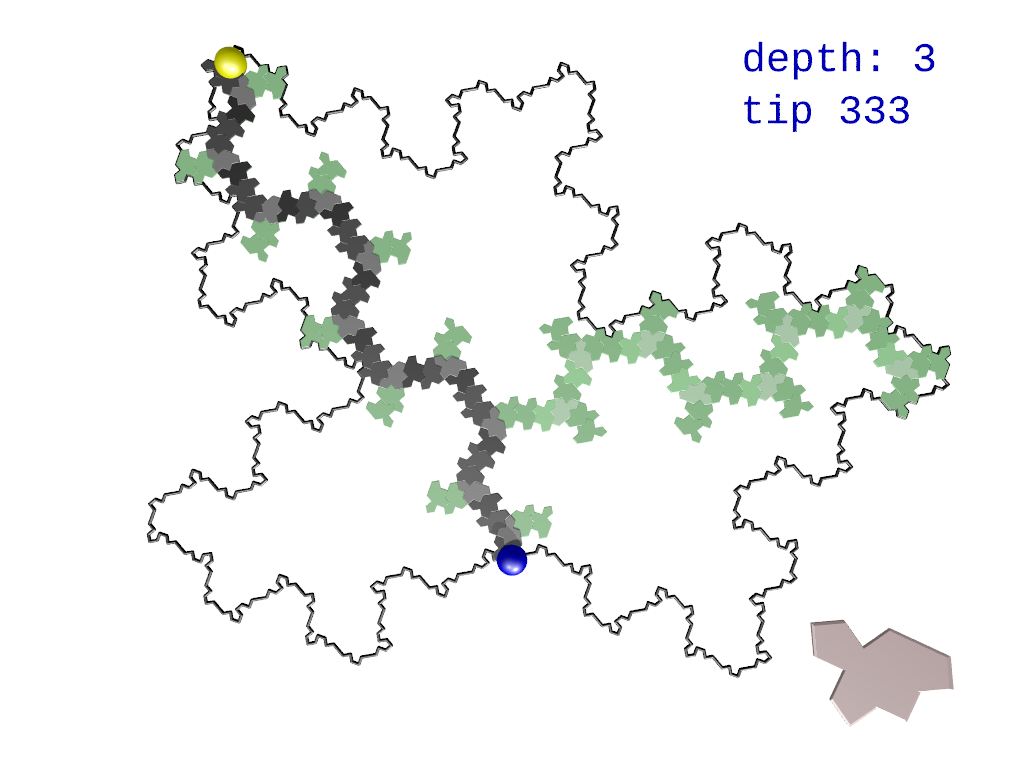
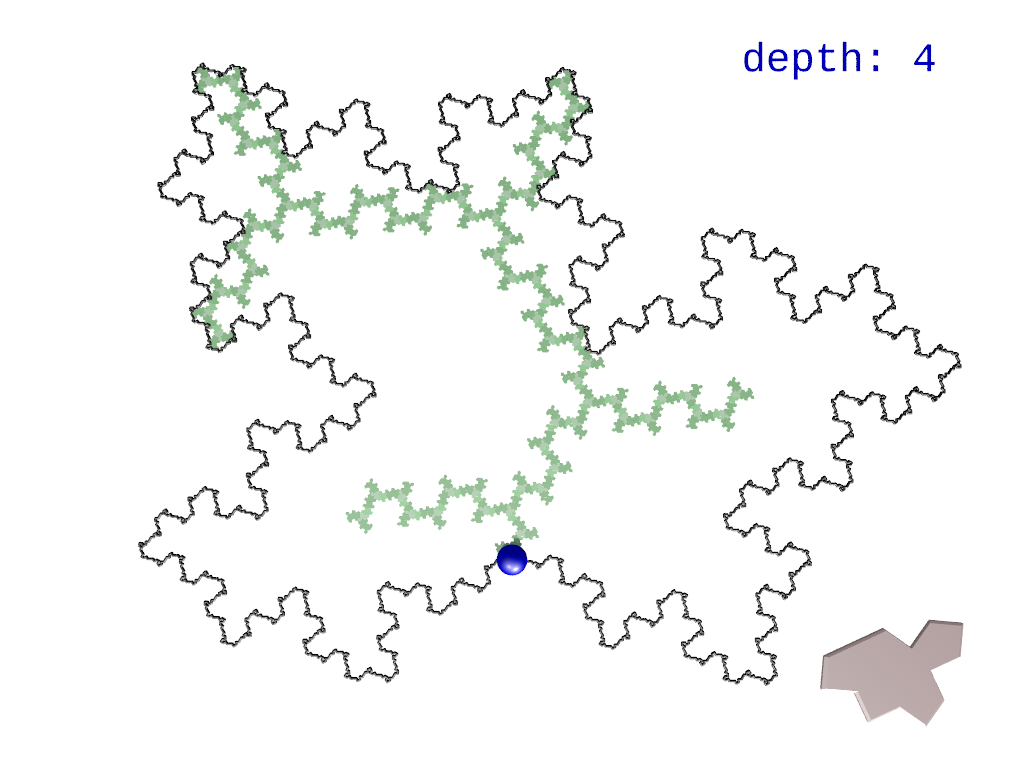
Worms (or snakes) are wiggling sequences of tiles that can be all reverted without any perturbation
of the surrounding tiles except at the worm tip and tail.
As a consequence, a bi-infinite worm can be reverted without influence on the rest of the tiling.
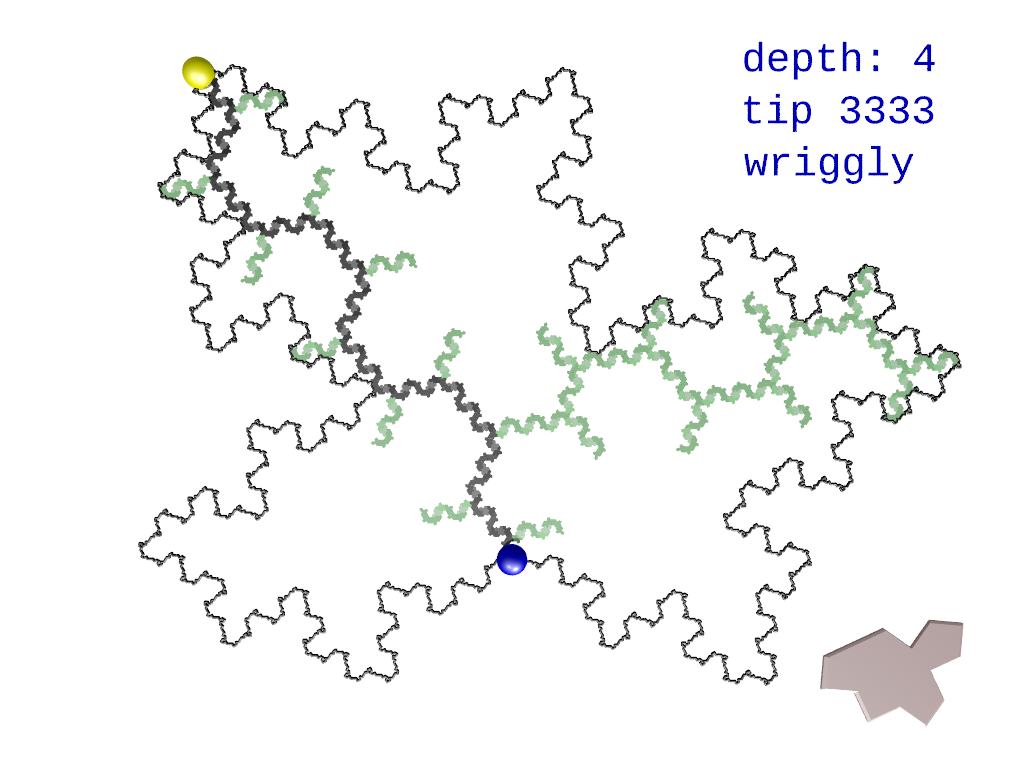
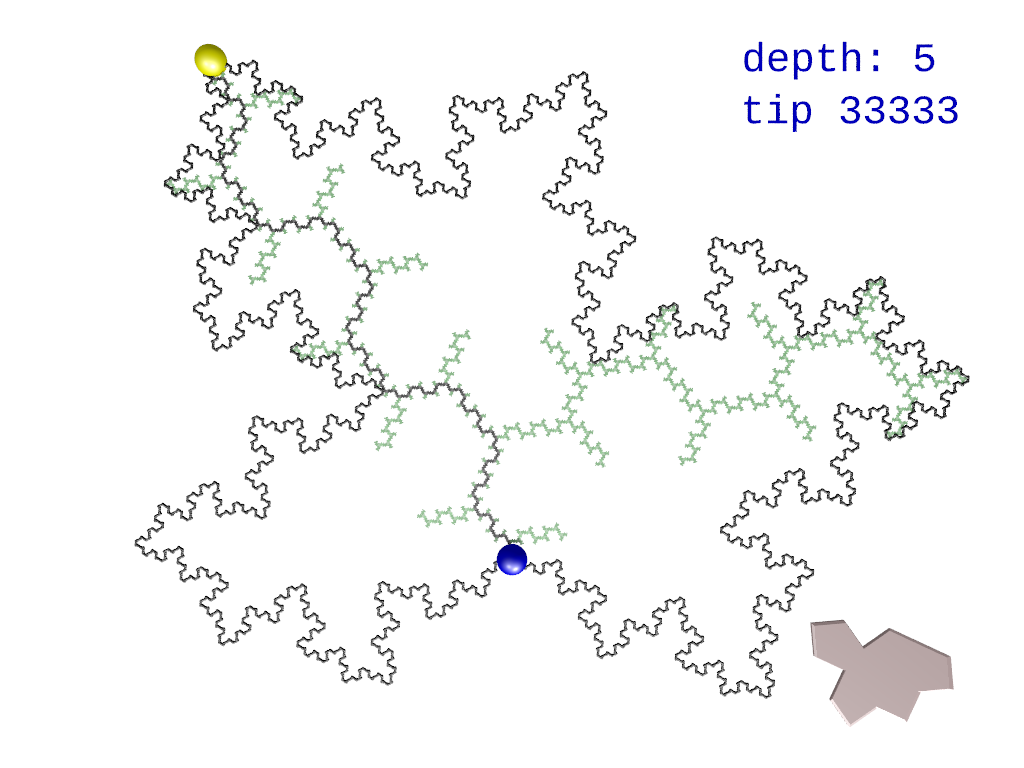
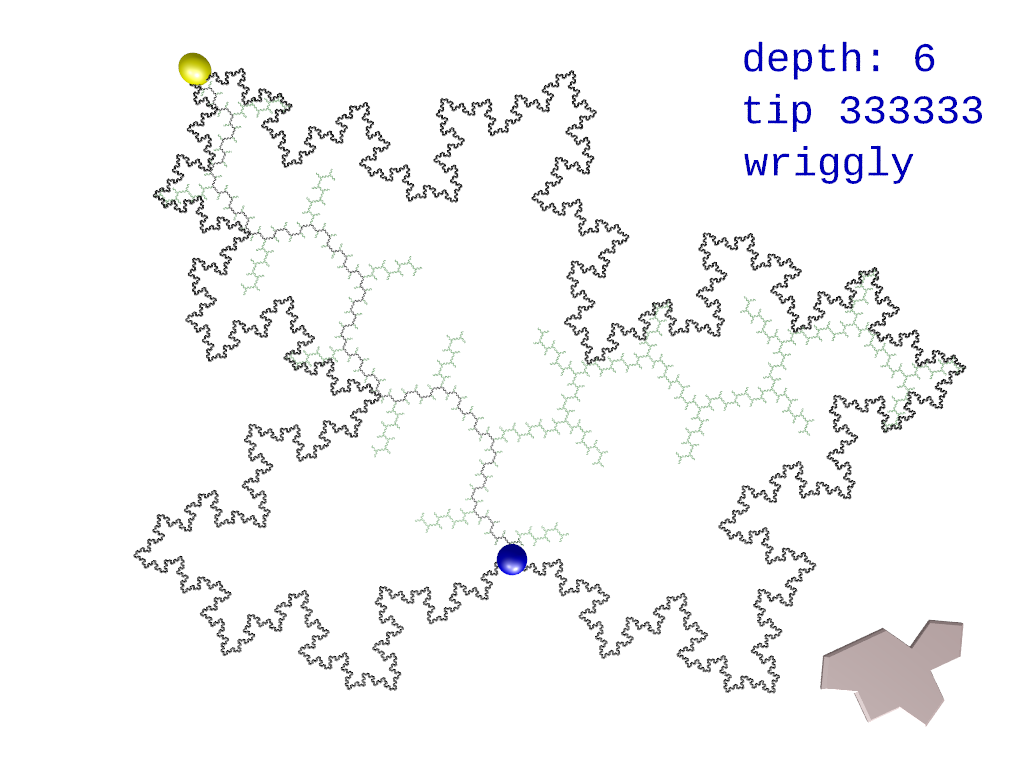
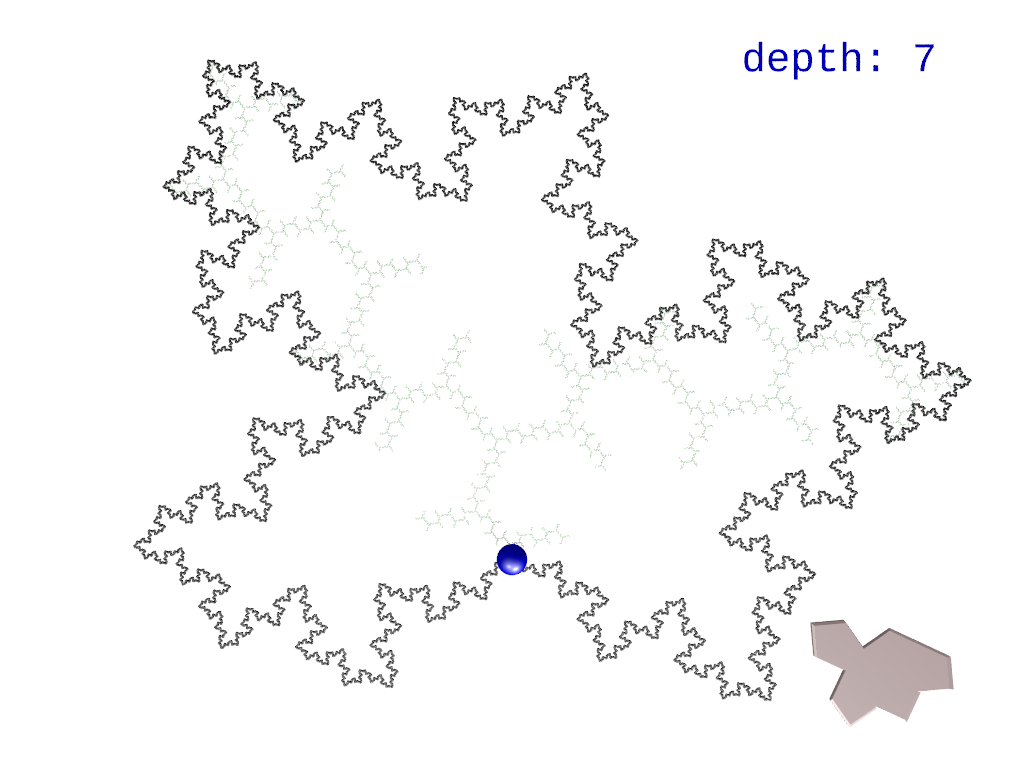
The black worm in the images connects the boundary point with address "...333." to the base point with address
"[0].".
Observe that only at odd depths this worm walks through the center (address "[40]." or "[04]." where the tripod observed by
Joshua Socolar is located.
The green paths show potential worms. Most of them have an internal tip (end point), thus cannot be bi-infinite.
Wriggly worms
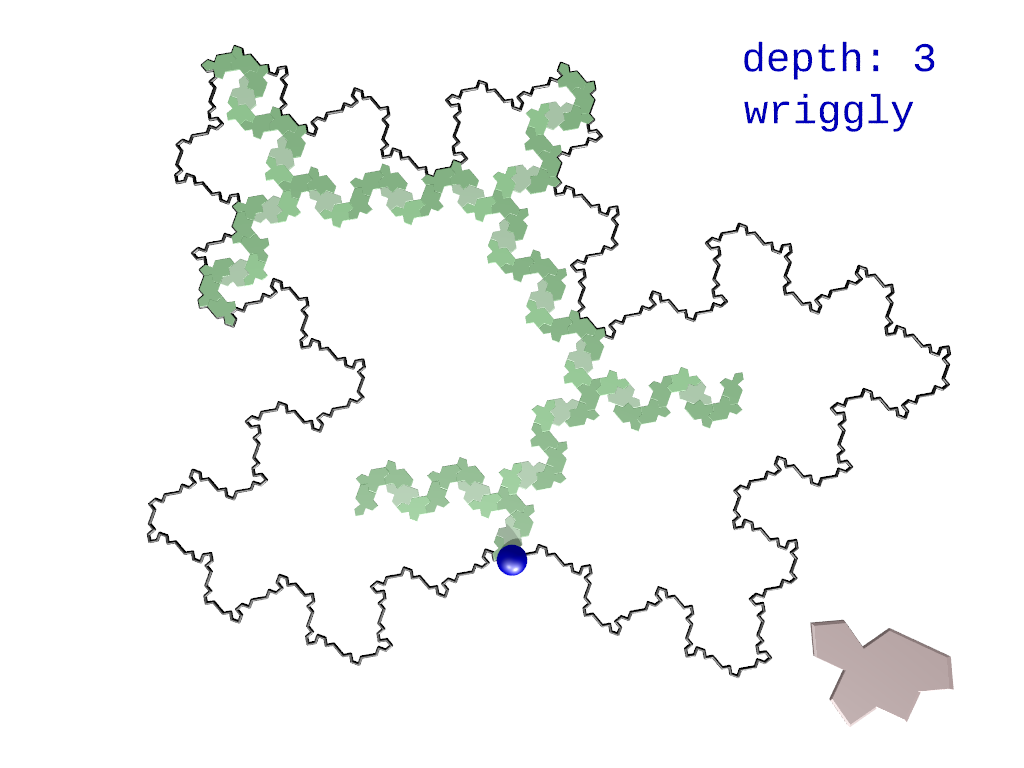
In addition to the worms shown above we can find wriggly worms, shown in white here.
Animation of a wriggly worm at depth 4.
A zoom of one of the images above
The two hydra tilings
[See also here to find the same two tilings from the perspective of their Conway signature]
Partial tiling with Conway signature "[5]."
has density 5/6 (roughly meaning that it covers 5/6 of the plane) and can be completed into a full tiling by disjoint union with the
partial tiling "[3].".
Looking at it from the point of view of worms and wriggly worms we find one bi-infinite worm and one bi-infinite wriggly worm,
both passing through the central point.
In addition we find four semi-infinite worms and four semi-infinite wriggly worms.
Upon removal of all these infinite and semi-infinite worms we are left with a 60 degrees rotationally symmetric structure.
| Tiling core | Overview | Zoom |
|---|
| Hydra 1 |
|---|
 |
 |
 |
| Hydra 2 |
|---|
 |
 |
 |
The two tilings above after reversal of the black worm:
| Hydra 1 with black worm reverted | Hydra 2 with black worm reverted |
|---|
 |
 |
The tripod tilings
They are actually two tilings that alternate by subdivision having signature respectively
"[40]." and "[04].".
The interesting feature is the presence of two complete worms sharing the first half (arriving from the South)
and departing in two different directions.
Here the two tilings are computed respectively with depths 5 and 6.
How a worm deflates under H7-H8 deflation
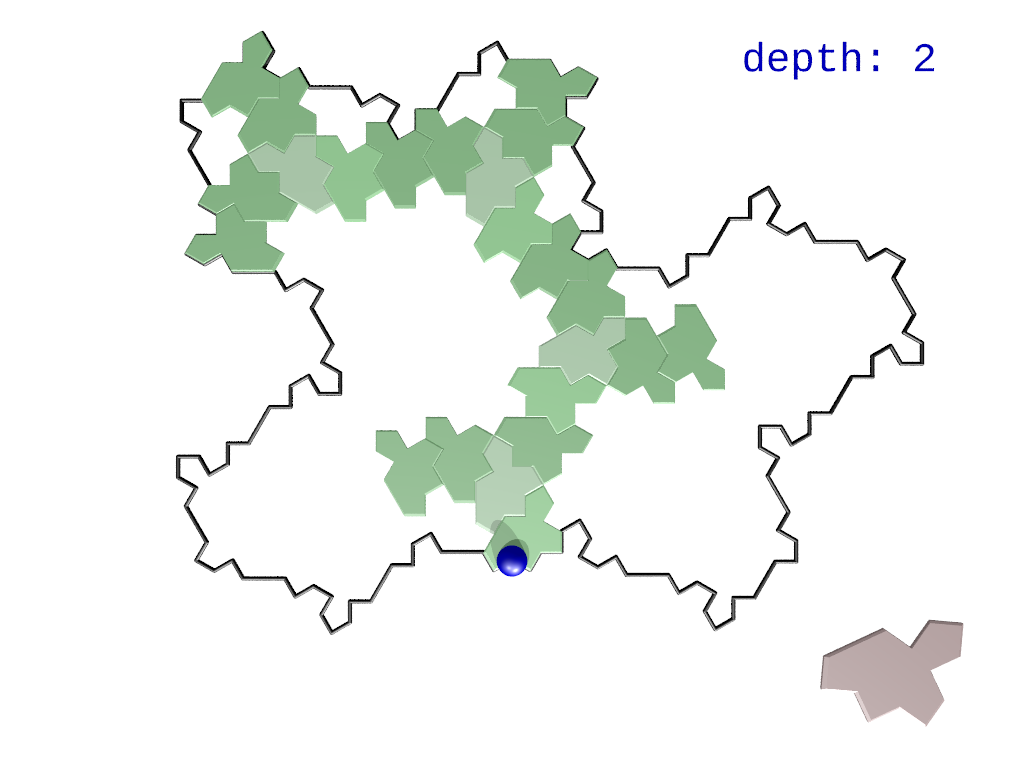
The images below show the result of a number of deflations of a spectre tile with only the
tiles forming possible worms ending at the origin (blue dot) displayed.
The first two rows show that repeated deflations of a worm produces a wriggly worm and
viceversa.
To facilitate comparison we use reflected tiles when the depth is odd.
The third row of the table reverts wriggly worms into non wriggly worms and
vice-versa.
The yellow dot, when present, show the tipping point of a specific worm (displayed in shades of gray).